by Jeffrey Bell-Hanson
There is an old saying, “You can’t tell a book by its cover.” It’s probably one of those idiomatic English expressions, but I suspect that it translates pretty well. For those of you just joining us from outside this cultural bubble, the expression means that appearances can be deceiving. One who appears disheveled, clumsy, and confused may actually be a brilliant Nobel laureate. Or one who appears well-tailored, socially at ease, and focused may, in fact, be a sociopathic monster. But it’s more than that.
The “book” in this expression refers to the whole truth or story of something or someone. The “cover” refers to some snapshot image of a moment in that story. Romance novel covers seem always to picture the moment just before the most salacious passage in the book. Science fiction novel covers often show us the point of furthest remove from our lives and experience. We, who buy the books, know that. It’s baked into our decisions at the newsstand or the Kindle store. We count on the story being much more interesting and nuanced than the picture on the cover.
Why do we find it so difficult to cut a living being the same slack? Why is it so hard to picture the woman who just took my order at Burger King as the PhD chemical engineer that she once was before she left everything behind in her home country to escape the horror of war? Why is it so impossible to think of the gnarled old man sitting on a park bench as the husband, father, brother, son, friend that he was before time and the unpredictable cruelty of life ravaged him and everyone and everything he loved?
Even harder still, why do we so often see a woman or man who seems to have grabbed life by the horns, and fail to recognize the pain and suffering that she or he endured on the way to that apparent triumph?
It is far too easy to see someone in a moment of strength or weakness and assume that what they are at that moment is their essential truth. We know everything we need to know about them. End of story. But a moment of deprivation and vulnerability may blind us to the tough and capable person in front of us. On the other hand, we may fail to see in someone who seems to have mastered her circumstances, the fragile person who has often been desperate for the compassion of others. We see only the strength, or the weakness, but we lack the crucial context of the story.
I have a lovely dog named Chloe. To the drive-through baristas who see her sitting regally in my back seat each morning when I am getting my coffee, she seems prim and proper, aloof, and even a little bored. It would seem, by all indications, that she has it made. But I learned today, because she had some x-rays, that years ago, when she was a young stray roaming the streets living on the scraps of food she could scrape from the pavement, or an occasional mouse that she could catch and eat, someone shot her with one of those air rifles that people use to target “vermin.” Apparently that’s how someone saw her then. No one really knows what happened except Chloe, who has been carrying the slug around in her hip ever since. She licked her wounds and continued to survive. At some point she was taken to the shelter where we found each other. Perhaps now she does have it made, but it was no easy road getting here.
It’s easy to see in Chloe a pampered pet. But unless you know about that slug lodged in her hip, you don’t know her story. Without knowing the story, you probably won’t recognize the strength and resolve that helped her survive.
As it has been with Chloe, how blind might I be to the strength or the vulnerability of the people around me? It’s too easy to dismiss someone I see on a street corner, or on a park bench, or at a freeway exit on the basis of that moment. The vulnerability and need is all I can see. I may as easily dismiss the rich or seemingly powerful person as one without concern or care, never recognizing the pain that she may have endured in another time and place.
Our stories matter. They make us who we are, not just what the moment may make us appear to be.
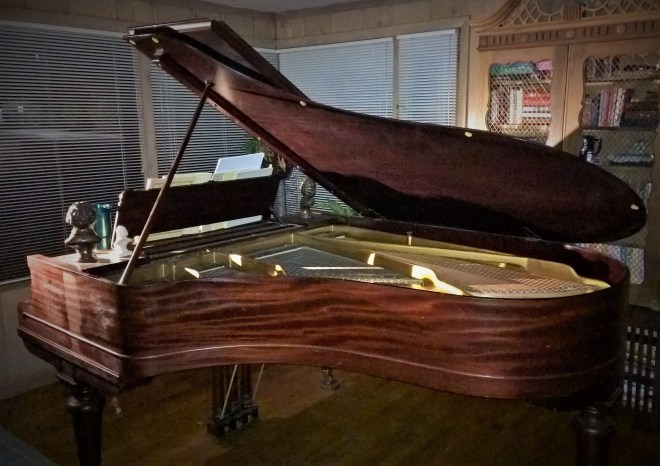 This picture of my piano, Henry F. Miller 40603, has appeared in my blog entries before. I’m including it in this one because I am thinking about the arc of its history. Made in 1910, this piano is now going through its second global pandemic.
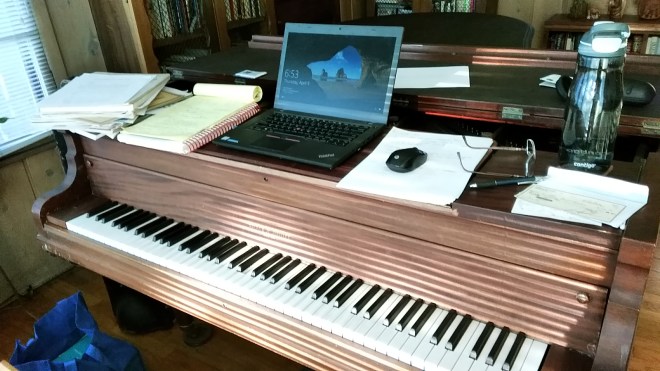 This is how the Miller looks in this global pandemic, 102 years later. It’s not so much providing solace for a family as it is helping to provide stability for students. It has become the platform (figuratively and literally) from which I interact with them online. It’s helping to keep their educational experience going, providing them with at least a hint of normalcy, and making it possible for me to continue to do at least part of my job. While I don’t know for sure, its voice may be traveling farther in this circumstance than it has in its entire history up to this episode.

 Beating in Air