Finding a Plan B—Just In Case

by Jeffrey Bell-Hanson

My search, dear readers, for information about the history of my piano (Miller 40603) prior to its appearance in my rehearsal room at Michigan Technological University is, for the moment, stalled. I am here in the Keweenaw Peninsula, where my piano and I met, for another week. Perhaps in that time I will find a clue about its life prior to our first contact. I still believe very much in the potential for this story to be instructive and inspiring. But I have to be ready to accept a dead end. (Please, let it not be so!)

But…if nothing comes of my search for information about this wonderful instrument, I can still go back the 2,000 miles I have traveled away from my piano, stop worrying about where it has been, and just enjoy playing it! It is a wonderful, life-affirming experience to call forth musical sounds from that keyboard, and it feels like a privilege to know that I am only one of perhaps just a few to have shared that joy. Maybe that should be enough. Nevertheless, I would still like to know more about the probably small community of which I am now a part.

If that doesn’t work out, my exploration in the Michigan Technological University Archive has already produced something else that is really intriguing. In 1913, there was a major strike in the Keweenaw peninsula. The Western Federation of Miners had organized in the area, which was economically dominated by the fiercely anti-union Calumet and Hecla Mining Company. The local union members went on strike for better wages and working conditions. It was a time of bitter strife between the workers and the mines. Before its end, it would result in the horrible Italian Hall disaster, during which the still extant ballroom of the Calumet Theater would become a makeshift morgue for the seventy-three fatalities, sixty-two of them children.

During that same tumultuous year, when the social fabric of the Keweenaw seemed to be coming apart at the seams, the Matinee Musicale Club of Calumet was founded and federated. The organization was formed by a group of women in and around Calumet as part of a national movement to organize women around the goal of improving understanding and experience of their musical culture. This movement was built on the traditional expectation for women to develop some musical facility—usually at the piano—as a sign of social cultivation.

One of the interesting aspects of the “yearbooks” of this organization was how the membership lists very quickly changed from Mrs. John Q. So-and-so, to using the women’s own names. This change happened within four years, though it was not a consistent convention for the next few decades.

They began by studying the music of dead white composers from the previous century, but within a short time were exploring women composers from the new world, and the new century.

I don’t yet know who the founding members were, beyond reading their names. Were they only the wives of the mine owners and executives? Or were there some members from outside that circle? I know that some of the members decades later were from working-class families, because I recognize some of them. They were still movers and shakers in the musical community when I came along in the eighties. How long did that democratization take? How did this group and others like it in the area influence the culture of the community in general?

If I continue to find only dead-end streets on my journey to learn about my piano, there is another fascinating story to be explored. It is a story of our American musical culture in an isolated, but once-thriving industrial community. It is possibly a story of how the attention of a group of women to nurturing that culture may have helped create a much more resilient community that enabled it to survive the inevitable decline of its primary industry, and allowed it to remain vibrant into the twenty-first century.
Finding a Porthole to the Past

by Jeffrey Bell-Hanson

Today is Sunday, October 29, 2017. It’s Reformation Sunday in the 500th year since Martin Luther acted to reform Christianity. Wow, that seems important! So I hope I won’t feel guilty if I remember this day as the day when the clouds seemed to part a bit in my search through history for the story of my piano, Henry F. Miller 40602.

Today I celebrated the eucharist at Gloria Dei Lutheran Church in Hancock, Michigan. But I’m here in Hancock in order to pursue archival research in pursuit of the history of my piano. It was a lovely service. Then I went to lunch with some of my favorite people, and a couple of them suggested that I call another friend who has been active in the musical community here in the Keweenaw for decades. So I called.

Wow! What a great idea. Our mutual friend had been thinking recently about the occasion, years ago, when she was asked to help evaluate the suitability of a grand piano for donation to a local church. In the end, they decided that this was not the instrument for their church. So the piano stayed where it was at the time. That makes it more likely that it was the instrument that was donated to the university where I acquired it a few years later.

More significant is that, if true, I have now have some names. I have the name of the potential donors of the instrument. I have the name of a family who may have owned this instrument for decades. This family has some pretty serious musicians going back for at least a couple of generations. If they acquired it from someone else, I now have a much better chance of finding that original owner. Or perhaps there are more layers. I feel a lot better now about my odds for penetrating those layers than I did this morning.

I wonder if it’s like this all the time for historians: months of deadlock, and then a sudden breakthrough. Maybe I got lucky. We’ll see, but what a euphoric feeling!

A Very Disturbing Dream

by Jeffrey Bell-Hanson

Dear Readers, I had a dream a few days ago, and I have debated about sharing it. It was one of those “Aha” moments that terrifies me.

First, let me tell you that I have some strange ideas about dreams. They seem to take me to places that are familiar but unknown. I have had dreams set in places that I could swear I have lived for years, but, upon reflection, bear no resemblance to any place I can remember living—in this universe. That really tells you what crazy things I may think about my dreams. Truth is, they probably are all about things I am trying to deal with here, in this universe.

This dream seemed familiar, as if I had had it before. I was being bullied…and not for the first time. This bullying was part of a pattern; a ritual, actually. In fact, the occasion was some sort of cultural or religious pageant during which young people (I am always much younger in my dreams) were asked to play roles. Some played the abusers, some played the abused. I was the latter, and it seemed like I had always—every year—been the latter. It seemed like something that I just had to live through so that I could go on with my life, knowing that next year, it would happen all over again.

But on this occasion, it occurred to me to question why this had to be. Why, for heaven’s sake, was I always in the weaker role? Why were the same guys always in the role of the abusers, beating up on me? What was it about me that made me seem like the weak one? Was there something about my size? My shape? My face? And I fantasized about turning that casting on its head; about unexpectedly turning the tables, doing some fancy martial arts and punching my way out of this situation. The delicious feeling of beating up my abusers was so appealing!

Alas, I knew it would never happen. Even if I knew the right moves—knew some martial art that would help me master this abuser, I knew that being the abused was what was expected of me. Nobody would support my unexpected escape. There would just be another abuser behind this one; one that was now damn mad about my upsetting the paradigm. For some reason, I was destined to play the role of the abused.

I woke up, thankfully, realizing that this was not actually my reality. I have been saved from lots of nightmares that way. But this time…I realized…that so many people I know…and like…and love…have not been able to escape this reality. And I am so ashamed it has taken me so long to understand it.

Accessing Our Voices

by Jeffrey Bell-Hanson

Dear Readers, I had the privilege of working with one of our state’s great high school orchestra programs yesterday afternoon. Maestro Doug Longman was kind enough to invite me to Issaquah for a rehearsal with his Evergreen Philharmonic. For those of you who do not know, the EP is a system-wide auditioned ensemble in the Issaquah School District open to students from all of the district’s high schools. Maestro Longman has labored many years to hone this ensemble into one of the region’s best.

I have been fortunate to stand in front of this group as a clinician before. Each time I do I feel compelled to remind these young people how lucky they are to have such an opportunity, and to have such a caring, capable and dedicated mentor—who is also a tremendous musician. The work ethic they unfailingly display tells me that they don’t really need to be told, but it seems like the right thing to do anyway, just to make sure all of them understand that these things don’t happen by themselves. Whatever joy they experience playing in this excellent orchestra comes at a price, one paid by their parents and grandparents, by Maestro Longman, by the taxpayers who fund their schools, the administrators and teachers who make them work, the section coaches and private teachers that many of them learn from, the luthiers and instrument makers who built their instruments, and on and on.

Yesterday, my short sermon on this privilege included some reflection on my time in other parts of the country where such opportunities are more rare and much harder to create. I was thinking especially of my years in Michigan’s Upper Peninsula. Beautiful as it is, it is also rural, isolated and sparsely populated compared to Western Washington. The critical mass of elements needed to make any orchestra there is infinitely more difficult to achieve, let alone one just for high school students. Yet dedicated teachers and musicians do make it happen—in some places. But there are many students there who do not have such an opportunity. For them, any sort of ensemble in the school or community or the availability of an instrument at home can be a lifeline to a means of reflection and communication that seems to be essential to human beings. It is essential because so many have, and so many continue to find their voices in these opportunities. Whatever people eventually do for a living, many realize their sense of agency when they are making music.

Herein lies the intersection between my life as a conductor and orchestral educator, and my research project this year on the provenance of my 1910 Miller piano. When it came to our household twenty years ago, it had clearly been maintained and used during the first eighty-seven years since it’s manufacture. It had been taken to Upper Michigan, probably in the early part of the twentieth century, to a community that, though isolated, aspired to sponsor a thriving musical culture. There was a new public opera house—one of the first in the country built by a municipality. There were company bands, ballrooms, union halls, churches, recitals, perhaps even salons. Whatever part this instrument played in that scene, it represented an investment in the musical present and future of a community. Given its size and character, it was a considerable investment.

The Evergreen Philharmonic is evidence that we continue to make those investments today. Yet once one leaves our urban corridors, these investments become much harder to sustain. Perhaps this is yet another reason for the isolation and division that we increasingly experience today. We are the most prosperous nation in the history of human kind. If we can’t find a way to provide for ourselves and our posterity the types of cultural opportunities that allow us to find our voices together, then who can?

Standing Against the Wind

by Jeffrey Bell-Hanson

Dear Readers, I am in a moment of crisis. The realization dropped on me this morning as I knelt at the altar to receive communion. Had it not happened then and there, the weight of it might have crushed me. For those of you who do not profess a religious faith, I promise that this post is not specifically about mine, and is no effort to proselytize. It does begin, however, with the premise that everyone has faith in something, like the love of a parent, sibling or spouse, her own resourcefulness, perhaps that the sun will rise each morning, or simply the earth under his feet.

I realize, of course, that it is easy to sense an atmosphere of crisis just now. The Caribbean seems intent on launching one massive storm after another at us, parts of the west are burning out of control, our neighbors are wracked by deadly earthquakes, tribalism is on the rise around the world, there are wars and rumors of wars that seem louder and more imminent with each passing hour, and there seems no escape from the disfunction in our society that was once covered with a veneer of civility. What progress we thought we had made appears to be crumbling away, uncovering a cruder, meaner and harsher reality that it has been all too easy for some of us to ignore.

What hit me this morning was not that I was living among crises, but that I am in a crisis, and have been for years. I have been able to distract myself from it with the world around me until now. But in trying to escape the turmoil without I have finally had to face the turmoil within. Its sources are mine alone to confront. What mattered most in that moment of realization was knowing to what I could cling; how to affirm my faith.

Three things presented themselves immediately. One was a story that I heard for the first time this morning in the pastor’s sermon. An American missionary was asked to leave China after the end of World War II, and on the way found himself in India among a community of German Jewish refugees. He cashed in his ticket home to buy them the German pastries that they had told him they so missed, as Christmas gifts. When they said to him, “but we don’t celebrate Christmas,” he replied that it didn’t matter. He did.

That story reminded me of two Methodist pastors that I knew, one from Michigan, the other from Omagh, Northern Ireland, who exchanged pulpits for a month in the late summer of 1998. The pastor from Michigan was there in Omagh when a bomb took more lives than any other incident during “the troubles.” The pastor from Omagh returned to his city as soon as he could, but in the meantime, both of them agreed that the pastor from Michigan would stand with the people in this afflicted place and render whatever token of God’s love that he could—which he did, not from any special connection with them, but because of his connection with his faith.

Standing in faith is not, however, only something motivated by religious belief. It is rooted in knowing in one’s core who one is and what one is about, and then remaining determined to be that person and to do that thing no matter what tumult comes one’s way. Which brings me to Leonard Bernstein, who famously said, “This will be our reply to violence: to make music more intensely, more beautifully, more devotedly than ever before.”

Yes, dear readers, I am in crisis, facing a headwind, as perhaps many of you are too. If you pray, pray for me, as I will for you. If not, keep me in your thoughts, as I will you in mine. Remembering who we are and what we are about, we will stand together against the wind.

An October Mystery

WP_20170825_22_28_54_Proby Jeffrey Bell-Hanson

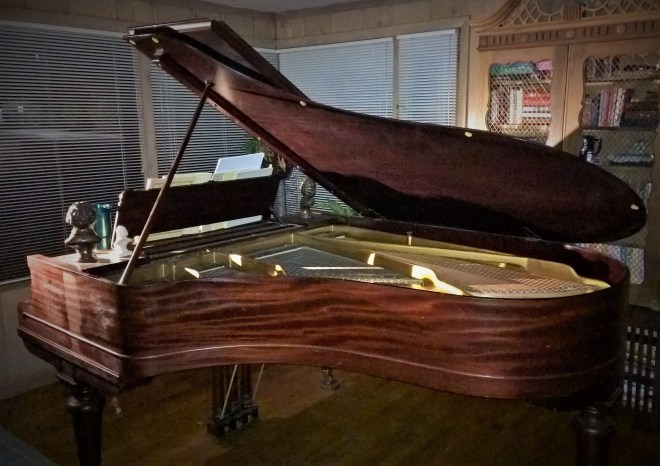
Dear Readers, let me introduce you to my beloved piano, a magnificent instrument that has graced our living room for about 20 years.

It was manufactured by the Henry F. Miller Piano Company of Wakefield, Massachusetts 107 years ago at what one might consider the acme of the company’s history. Miller, as a young man, was an aspiring keyboard artist. However, as has been the case for musicians then and now, he soon realized the need to have a “day job,” and in 1850 joined a then prominent Boston piano-making firm, Brown and Allen.

He founded the Henry F. Miller company in 1863 just as the industrial revolution brought steam-power to factories in Wakefield. While never as large as the behemoth Chickering company in neighboring Boston or Steinway in New York, by the turn of the century it was making instruments that rivaled the quality of pianos made by these two giants, and which were increasingly played by prominent artists of the day.

Like most American piano manufacturers, the Henry F. Miller and Sons label became subject to a long series of acquisitions in the 1920s. Over the course of the decades, the Miller brand became associated with decent, but lower-priced instruments pitched at the entry level of piano purchase. Production of Miller pianos (by the Pearl River Company in China for Sherman Clay in the US) final came to an end in 2013 with the closing of the Sherman Clay stores.

This specific piano can be traced through its serial number to the original Wakefield factory in 1910. It is 6 feet and 9 inches long, which makes it roughly equivalent in size to the Steinway B, the instrument with which it was no doubt meant to compete. The size makes it best suited for smaller recital halls and studios, though it is sometimes found as well in music rooms in larger homes. Without doubt, it is a pianist’s instrument (though I make no claims for myself), not generally what one would purchase for occasional sing-alongs in the parlor.

I acquired it in a remote corner of Michigan years ago after it had been donated to the university at which I was employed. At the time there was no suitable place for it, no immediate use for it, and no budget to do the sort of restoration that a (then) 87-year-old piano needed. Making matters worse, it suffered the collapse of one of its legs when it was not moved carefully enough. After the damage was repaired, the decision was made to not risk the same thing happening again, and it was sold, as is, for what was deemed a fair price—to me! Even after the accident, it still holds pitch beautifully and has a powerful sound throughout its range, indicating that the soundboard is likely in good shape.

Now for the mysterious part, and the object of my quest: How did it get from Wakefield to this rural mining area on the Lake Superior shore? Who brought or purchased it there? How did they use this large, artist-quality instrument? Was it in a ballroom, a house, perhaps in a church hall? Was it purchased by a wealthy mining company executive for an especially serious pianist in the family? Were piano students taught on it? How many lives has it touched and what role did it play in the musical community of this once-thriving mining region?

The one key piece of information that I do not have is the name of the person who donated it to the university. Oddly, there seems to be no record, as if it were left on the doorstep like a baby in a basket. Perhaps its story is not all that interesting. Yet it seems like a once-well-maintained instrument. It’s possible that it has a fascinating tale to tell. Finding clues at this stage, however, is like searching for the proverbial needle in a whole bunch of haystacks.

To What Do I Pledge My Allegiance?

By Jeffrey Bell-Hanson

Sorry to those who either look to this blog for news about music-related issues, or who just want to avoid politics, but I did say that there might be some questions asked to readers. I posted some questions on my Facebook page recently that I felt ought to be asked in the wake of the uproar over the “anthem protests” in the NFL this fall. Of course they are not anthem protests. They are about what many believe to be unjust practices of our police with regard to citizens of color in the United States. (Even saying that trivializes it. These gestures of protest are about, at long last, achieving true justice in American society.)

But the protests have been designed to grab the attention of many of us who so easily tune this stuff out because it doesn’t affect us where we live. We can find all sorts of ways to avoid walking in each other’s shoes (or skins), but put it between us and our football games? Seems to have touched a nerve.

So, I wanted to explore the nature of this phenomenon of anthem/flag-worship. To that end, I posted the following questions to my Facebook page:

  • When you stand for the playing of the anthem, if you do, why do you do it?
  • Are you making a genuine expression of national pride in some aspect of what the country means to you, or are you doing it because people are watching and might think badly of you if you didn’t?
    • Follow-up: If it’s the former, what is that thing that inspires your sense of pride? Is it the hauntingly beautiful tune, “To Anacreon in Heaven,” or the striking combination of red, white and blue in “Old Glory,” or is it something less material, but also less abstract about your experience with life in the US?
  • Do you stand and put your hand over your heart if you’re in your living room watching a football or basketball or hockey game?
  • Should you, as Sarah Huckabee Sanders said, view this as a black and white decision (an unfortunate choice of words) that “all Americans should be proud to stand and salute…and be part of that process”?
  • Do you agree with the president that we “can’t” have football players protesting in this way?

One of my friends (not just a Facebook friend, but a childhood friend) replied about his deeply-held convictions about honoring our country and those who serve it, including his friends and close relatives, and his own service. After explaining his feeling for these symbols, he expressed his belief that a respect for all that stands behind them should not abridge anyone’s rights to voice their grievances. He thinks this whole kerfuffle is a distraction. To which I would reply:

You’re right. It’s a distraction. But it’s still good to ask ourselves about our relationships with these symbols of our country. Here’s a bit about mine.

My dad was a conscientious objector in WWII. He was raised in one of the historic pacifist churches and had deep-seeded beliefs about war and its effects. His beliefs put him in a very small minority in this country during a war that we often look back on as one with particular moral clarity for our country. He and his family felt the sting of that minority status. His position was legal, but often regarded as traitorous. Nonetheless, he was a patriot who loved his country and wanted to serve it. Thankfully, he was given the opportunity to do so during those war years by helping to care for the mentally ill here at home.

Perhaps somewhat reflexively, he was wary of overt expressions of patriotism. It wasn’t because he wasn’t proud to be an American, but because he understood the complexity of what citizenship means. His reaction to the World War II Memorial in Washington, DC made clear his deep appreciation for the ideals of this nation. His friends, his classmates, and countless others of his generation—who did not agree with his choice during the war years—nevertheless sacrificed for his right to make that choice. No one understood that better than he did.

His idealistic beliefs were a powerful influence on me as a youngster. Yet with the passage of time I have come to see the complex relationship between idealism and community. So, I, living and working for years near Joint Base Lewis McChord, would often stand with my hand over my heart when I heard the anthem being played at about 4:30 in the afternoon, in my office, in my house, or wherever I was. I wanted to honor this country—my home—and those who serve it in the military, and in every other kind of public and private service, because doing so makes a space where what my dad believed and lived out is as valid as the beliefs of the members of the flight crews passing over my head in C-17s.

I have said little about the cause for which our sports figures are currently demonstrating. Hopefully this form of protest will lead us down a path toward a serious discussion of the justice that they rightfully seek. Their cause is older than our country, and is too long overdue for a resolution. What I seek to address here is the controversy over the means of their protest, and the reaction of our government to it.

As a musician, I have lost count of the Star Spangled Banners I have played, sung, or conducted, or the postings of the colors in which I have taken part. I have never really questioned the ritual or communal importance of these expressions. But, if someone ever required me to stand and salute when I heard the anthem or saw the flag, that’s when I would “take a knee” without question.

Next: (And this time I mean it) Exploring a piano’s past—It’s a mystery!

Redefining Relevance

by Jeffrey Bell-Hanson

September 8, 2017

This morning I found myself in an early department meeting, despite my sabbatical leave officially beginning a week ago. Let’s not dwell on the reason for me to be there, other than to say it was not a pathetic attempt to feel needed. My presence had been requested. Nevertheless, just after adjourning one of my favorite colleagues suggested that I should come home and take a nap. While I knew this was a well-intended rib, it still sent a bit of a chill down my spine.

The first of the three sabbaticals I have enjoyed in my career (counting the one just begun) was short—a ten-week term—and came a little before mid-career, not long after I had finally finished my doctoral degree and achieved tenure for the first time. I had a research project and scores to learn for a concert in Europe. It was easy to fall back into the familiar rhythm of my days as a graduate student. It was a fairly rigid regime, but it was self-directed and pointed at tangible results, like an article to be written and rehearsals to be conducted.

This time, those graduate school days are far in the rear-view mirror. They don’t seem like such a relevant paradigm for organizing my time during this sabbatical. On the other hand, what looms much closer on the horizon is a time when I will be responsible for filling all the rest of my days (at least until the skilled-care nurses take over). Retirement is not imminent, but there are far fewer years ahead in my career than there are behind. So it is tempting to think of this year as an early rehearsal for that long sunset walk.

A sabbatical leave on the front range of a career is, like everything else one takes on as one climbs the professional mountain, about building your career—about becoming relevant. Why has the thought only coalesced in my mind today that this sabbatical leave is going to be about finding a way to stay relevant? I still have a research project. I still have scores to learn and some rehearsals to conduct. These activities engender no less enthusiasm in me today than they did twenty years ago. But will the passing of those two decades make what I produce this year more interesting to others, or even less?

Perhaps my relevance has to be defined differently now than it did early in my career. Or perhaps I just need to more clearly understand and accept the idea of the silent and ephemeral gesture from which this blog gets its name.

In the New York Times this morning I read a story about Melvin Redick of Harrisburg, PA, who, along with “a legion” of other fictitious Americans, posted links to emails, false stories and innuendo that apparently proved influential to our electoral politics. After all, if even a fake person can find a way to be relevant, then surely I can. Stay tuned, dear reader, for more about how I hope to do just that.

Naked Music Making

by Jeffrey Bell-Hanson

WP_20170805_14_51_45_Pro.jpg

I am sorry that I sucked you in with the word “naked.” I just meant “unvarnished,” or “raw,” or “improvisational,” or something like that. Shame on you for thinking otherwise!
For readers who have access to my Facebook posts, you may be aware that I recently attended the reunion of the Huskies Pep Band. This is not the one in Washington state that I once was mistaken as referencing (really just a marching band in disguise). I mean the real one—the Michigan Tech Huskies Pep Band, whose most recent motto is “the most fun you can legally have.” I was invited because…(gulp)…I am one of six previous directors of this proud organization. (What many of my current students have long suspected is true. My past is…complicated.)
Actually, I wear this mantle proudly, and now more so than ever. In the fourteen years during which I had this particular tiger by the tail, I did not fully appreciate what the organization was, either culturally or musically. It seemed far from my cup of tea (in spite of my history with athletic bands), and I tried to find lots of ways to create a sense of mission for myself and for them beyond our role with the athletic program.
Unlike my two predecessors in the job, I was not a sports fan. I had some professional credentials that might seem to qualify me for this leadership position. I had led the Notre Dame hockey pep band as a graduate assistant, and I had been the pep band director for five years at a junior college in Kansas with a fairly good athletic program. (Let’s not discuss how the coaches there regarded me.) I ostensibly understood the culture from which the imperative of the pep band arose, but I never really bought into it.
When I was being considered as a sabbatical replacement for Mike Griffith, my immediate predecessor with the Huskies Pep Band, what my record did not show was that I had followed my particular path because, during my collegiate years, my imagination had been fired by my experiences as an orchestral musician, not by any experience with athletic bands. In plain language, my work with pep bands was a way to stay employed while I worked my way into a career as an orchestral conductor.
Complicating that plan was my concern even then about the dominance of a zero-sum paradigm in our society. In as much as the pep band was an instrument of that paradigm, it seemed to me not to be a good way to employ my art. The band’s goal was the defeat of an opponent; not just the team, but their band too. We were banned from the hockey arena at our neighboring school, Northern Michigan University, because we competed with their band in order to help our hockey team win. Our paradigm dictated that it was us or them, and we were clearly there to make sure it was us.
I don’t claim, because of my attitude, any moral ascendancy. I enthusiastically led more than one of those “battles of the bands” trying to secure a win for us with someone else’s loss. But for what it is worth, I lost a lot of sleep during those years over the tension between what I saw as the zero-sum mission of the band and what I believed to be my role as a musician, a facilitator of community and a proponent of unity, not a combatant in a symbolic war of institutional identity.
What I am able to see more clearly with hindsight is the inexhaustible creativity and joie de vivre that the students in the Huskies Pep Band brought then and still bring to their performances. Outwardly, they seem to be the fiercest competitors one could imagine in a battle of bands. They love to win, which they don’t do by being a better or more disciplined musical organization; DCI they ain’t! Instead, they just have more fun than anyone else; and the depth of their collective imagination at finding ways to do so is astounding. The fact that they clearly don’t take what they do or why they do it or anyone around them at the time too seriously—that they are willing to make fun of anything and everything, but in the end make it clear that it all comes from a desire to share their fun with everyone—makes what they do unfailingly infectious and engaging. While they can appear to be playing a zero-sum game, in the end they always seem to stop short and dance away laughing. And everyone laughs with them, and claps, and sways, and smiles. They are the court jesters in their realm, and they use music in fascinating and intuitive ways. In the end, they often sound pretty good doing it.
While I don’t think I would ever want to hear them play Mozart, they are, in some essential ways, quite Mozartean. Most musicians could learn a thing or two from them, including me.

What comes just before now?

by Jeffrey Bell-Hanson

A few weeks ago I heard an interview on NPR with a novelist who had struggled in his writing with the tension between living in the moment and being concerned with one’s legacy. As I listened it occurred to me that we live in a world largely populated by beings for whom existence is almost wholly defined by surfing on the razor edge of the present moment. Among them, we humans are the most likely to be capable of seeing beyond the confines of now, though, as this author noted, only with some struggle.

As a conductor I am professionally consumed by a concern for the quality of the preparatory gesture. When something doesn’t go as planned, it is inevitable that I look to the moment just before to understand why. Any effect that I hope to have on the quality of a musical event has to be shaped in that prior moment. Yet it is only the sound which follows the preparation that embodies the significance that I intend. That is where my action comes to fruition for those to whom it is directed, including myself. For I am both the initiator and a receptor. I am a member of my own audience as much as I am a performer.

There are two points of interest to mention here that seem to parallel the tension about which the author spoke. One is the ephemeral nature of music. More than any other art form it illustrates an important truth about the way all creatures experience existence – one moment at a time. We live our lives looking through a small window—a pinhole really—through which we see only what can be seen right now. Past experience gives us some framework for understanding this moment, but its relevance can quickly fade as each new present comes and goes. And as we experience each moment, it can radically alter our perception of moments past.

Second, the conductor’s field of action is always ahead of the events in the musical present. Each gesture is made in a more or less rhythmic relationship to a musical event, as if it were in real time, but is actually slightly ahead of the arc of the music. Further, since those who actually produce the sound also have considerable agency in shaping the character of the music, there is necessarily an aspect of dialog between them and the conductor, but one that takes place at a pace that is defined in a quite different way than a dialog of words. The listeners also take part in this dialog, effectively extending the duration of each moment by the amount of time it takes them to perceive and apprehend the significance of an event. For all of us in that chain, that significance evolves with each passing moment.

There are different layers of preparation for the conductor, each occurring over a different period of time. From the moment of the gesture that initiates the sound, to the planning of a specific rehearsal, to the studying of a score, the training with a mentor, all the way to the initial experiences with music as a child. All of them will have some affect on the sound that comes out of the orchestra. But nothing matters quite so much as that gesture just before the sound.

Music effectively pries open our pinhole view of the present moment just a little, allowing us to contemplate and savor it with its deep connections to, or startling discontinuities with past and future. Ironically, the ability to evoke a sense of the divine, other worldly and eternal has often been claimed as its most important attribute. Even so, because it is so transitory, more than any other art form it engages us in a way that suits the primal now of our animal nature.