Love Letter to a Piano

by Jeffrey Bell-Hanson


Dear Readers,

For the last two weeks I have been away from home—not from everything that I love, but from many of them: my wife, my dog, my home in the Pacific Northwest, and from my piano. Ironically, it’s the piano that sent me off. If you have read some of the other posts in this blog you know all about my journey of discovery this year. I am trying to learn something about the history of Henry F. Miller 40603, the grand piano made in 1910 that has been in our household for over twenty of its years.

This last leg of my journey took me to the University of Maryland’s Michelle Smith Performing Arts Library and to the Library of Congress to see the Presto Buyer’s Guide to Pianos and Player-Pianos and Reproducing Pianos from multiple years of publication in the early part of the last century. It gave me a sense of where the Miller company stood in the pantheon of American piano makers. They had a reputation for an uncompromising pursuit of their founder’s goal of making artist-quality instruments. That was further reinforced by a visit with Charles Jackson, a technician, piano restorer, and piano historian in Hopkinton, Massachusetts, who showed me some of the measures that Henry F. Miller and Sons took to engineer their pianos to last. That explains a lot about number 40603. [http://www.pianomuseum.org/lobby.php]

I visited the site of the Miller factory in Wakefield, Massachusetts where my piano was made over a century ago. Whatever expectations I might have had about finding hallowed ground, what I actually found was this rather homely little bank, a tire store, and a parking lot all inhabiting that space where great musical instruments were once made with such dedication and care.

WP_20180516_13_02_46_Pro

But the streets were all there, and I could almost picture the old factory and the ornate town hall that sat next to it.
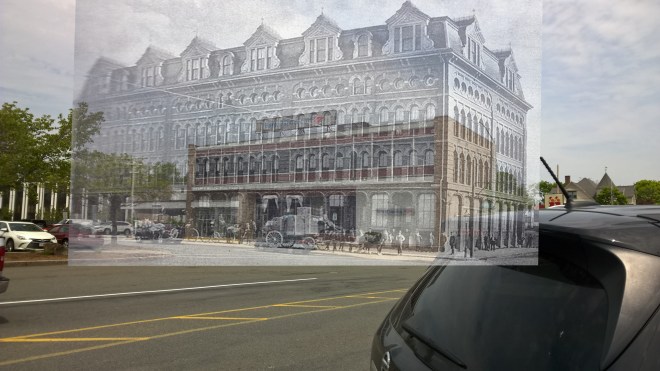
Miller Site with Factory

Equally interesting was my trip to see the Frederick Historic Piano Collection in Ashburnham, Massachusetts [http://frederickcollection.org/] where Patricia Humphrey Frederick and Edmund Michael Frederick curate a marvelous collection of twenty-eight working, historic pianos that date back to the eighteenth century. I spent nearly four hours listening to Edmund talk about and demonstrate most of them, starting with the newest and working our way down to the oldest. I began to get a sense of the evolving sound of pianos, and the craft and technology that has supported it. I sat down at a few and played them just enough to get a feel for the shallow, light and quick action of the older instruments, a characteristic that allowed pianists, in Edmund’s words, to execute passages as if they were making gestures over the keyboards.

This morning, after yesterday’s long journey home, I sat down at the keyboard of Miller 40603. I left the music rack down and just improvised. It was just so much harmonic doggerel, but it allowed me to feel the familiar weight of the action and hear what, now more than ever, sounds like an extraordinarily rich and resonant voice. I heard some wonderful instruments in the Frederick Collection—Erards, Bösendorfers, Blüthners, Streichers, a Steinway, and others. Their voices were distinct. Some were crystallin, some silvery, some richer and warmer, and they all had qualities that made them especially well-suited to music of a particular period, or style, or composer.

As I sat at the Miller this morning a couple of things occurred to me. First is how well suited it is to the music of its time. It was made when some of the late romantics might still have been considered contemporary composers, and some were even still alive. It is resonant, and warm, and lyrical, as their music demands. Second is how much in love I am with its voice. Maybe that’s because it’s familiar—it’s home.


A Real Nightmare

by Jeffrey Bell-Hanson

(Warning: This blog post contains violent images that may disturb some readers…they certainly disturb me.)
The dream that I recount here came in the wee hours of the morning, as the most disturbing dreams usually do. It woke me, but not in a cold sweat or ready to scream. The horror came over me slowly with the realization that emerged moments after.
As the dream began I found myself in a grassy place in the company of four or five students. The students were familiar to me, but I could not name them. We seemed to be on an old farm that was probably abandoned. There was a run-down wood-frame shed next to us, clearly neglected. The grass around us was long, but dry and yellow. In fact, the whole scene had a sepia-toned look.
The shed was on the edge of an open field filled with this long grass. It would have been difficult to see things moving in that grass, though there were bare spots here and there, particularly around where we stood. With the shed to our left there was a line of pea-sized gravel in front of us. It had been deposited neatly there in a ridge roughly eighteen inches high and seven or eight yards long. By whom exactly, I didn’t know, but this didn’t bother me. I felt we were there for a purpose, and I had a sense of what lay ahead. Somehow, I had become aware that we faced a battle for this piece of land, or the land behind us, or for some other reason that was not entirely defined.
I also thought that our opponents were to be the squirrels hiding in the grass somewhere beyond that gravel ridge. (At this point you may be thinking Monty Python and the Holy Grail, but I assure you, it didn’t seem cartoonish at all to me. It all made terrifying sense.) Our weapons were to be World War I-era bolt action rifles. They were piled nearby. The squirrels would be armed with rifles as well. Questions of scale did not occur to me. I just anticipated the horrific wounds that these weapons could, and likely would inflict on my students and me.
A small shovel appeared in my hands, so I used it to carve some channels through the gravel ridge. I varied the angles to create a more complete area of fire in front of us. (It was something I saw on television once.) My overriding concern was to protect my students as well as I could, but I knew that our small number didn’t bode well.
Suddenly I became aware that there were squirrels among and behind us, seemingly focused on what lay beyond our position. They were not attacking, but rather appeared to be on a reconnaissance mission. I assumed their peaceful presence to be the result of some code of honor that might have been observed in warfare at one time. I struggled with this for a moment. I knew that I should observe the apparent cease-fire if I were to maintain my honor. Yet I was convinced that these same animals would likely be shooting at us soon. So I struck one of them with my shovel. And then another. And another. They did not die easily, but each one looked up at me in astonishment as I beat it to death. I kept telling myself, “You are saving your students’ lives—and your own,” though I had no idea if this carnage would eliminate the threat. Even as I woke, I kept thinking that I was doing what I had to do by killing the little animals.
I lay awake for minutes before it began to dawn on me that the squirrels had shown no aggression toward us at all. I saw no evidence that they actually had rifles, and how absurd it was to imagine they could have lifted them, let alone fire them, if they had. I began to question the provenance of the whole scene. Who had put us there? Who had deposited the gravel berm and set the scene for a battle? Who told us that the squirrels were our enemies and were going to attack us? Had I just assumed them to be enemies when they appeared? Could they simply have been trying to escape whatever was in the grass beyond the gravel? Was there any enemy at all? Could the gravel have been there for another reason? Did I see danger where there was none and strike out at innocent creatures in unreasoned fear? … Could I be that monstrous?
Yes. It seemed that I could.
And then, no longer asleep, but fully awake and aware, I was truly terrified.

When the Past Matters

by Jeffrey Bell-Hanson

During a recent professional conference of college orchestra conductors, I heard some early American orchestral music that was surprisingly good. When I say “early” American orchestral music, I mean the nineteenth and early twentieth centuries. Our orchestral tradition is not as old in the United States as it is in Europe. When I say “good,” I mean well-constructed and well-orchestrated. It was also well-performed, but that was not surprising at all. My colleagues in this organization can always be trusted to produce impressive performances. And I say it was “surprising” because, yet again, we discover that what we once thought was a trickle of musical activity at a particular time in our history begins to look more like a torrent.

The research effort that unearthed these pieces in the Library of Congress and brought them to light is also impressive. Some dedicated scholar/conductors have spent a lot of time and effort searching this music out and producing legible and critical performing materials. This effort and its immediate fruits are worthwhile and praiseworthy. It is one of the reasons that I have come to believe so strongly in the value and power of professional organizations like this one.* Our particular profession tends to isolate us on our campuses. It is a rare university or college in the US where more than one of us can be found. That isolation would eventually lead the best of us either to question ourselves too much or not enough. So our professional associations, when we engage in them earnestly and energetically, make us all better.

Observing that to be true might also prompt us to reflect on the freedom that we have to form these associations and pursue their goals unfettered by any limitations imposed from some governing authority. Though we may not often think of our professional lives in constitutional terms, freedom of association, with professional colleagues or anyone else, is enshrined in our constitution. The effect of the first amendment on the freedom that we have to live every aspect of our lives is sweeping and profound. It is the proverbial forest that we often do not see because we live inside of it. One of its trees is the freedom to define our individual lives in any way that we choose, including those with whom we make common cause. This freedom also extends to our right as academics to the unfettered pursuit of knowledge and the examination of our collective lives through the artifacts and documents that we produce.

That freedom also obligates us to assess the impact of what we find. As a general principle, sunlight is the best disinfectant. But it is possible to imagine objects or documents that have been consigned to the dustbin of history because that’s where they belong. No level of musical ingenuity or artistic quality may redeem them. Acceptance of that responsibility is how we maintain this liberty, and is the other side of the coin for those of us living in a free society. The often-used platitude, “freedom is not free,” is much more than a summons for some among us to serve in the military. It is a mandate for all of us to accept the responsibility of governing ourselves in a way that contributes to our constitutional ideals, and not to use our freedom without considering the impact of our actions on others.

Our American orchestral history is bound to be, like all our cultural history, complicated. Our composers, conductors, and even orchestral musicians right down to the back-desks have inevitably lent their efforts to support the ideals of our political and social culture, and the structures created by our founders to embody them. Wittingly or unwittingly, they have also inevitably supported whatever local power structures have arisen within the society—for both good and ill.

As we unearth the artifacts left to us by our musical predecessors, it is incumbent upon us to evaluate not only their technical and artistic merits, but also the values that they support. It is an ongoing debate for musicians. When should we consider a work of art too tainted with the evils of our past to render it irredeemable? And the correlating question, is a work so valuable artistically that the taint should not matter?

We can disagree about the answers to those questions in any given case. The only unforgiveable sin is not to ask—before we bring a work back into the light of day. Some of them will go back into the archive at least until they lose their power to call on our darker angels. Some may stay there forever, and we need to be okay with that.

*College Orchestra Directors Association codaweb.org

Light, Dark, Balance, and the Way of the Force

by Jeffrey Bell-Hanson

Having been a Star-Wars fan from the beginning, it was wonderful to see the latest installment in the saga during my holiday visit with family, in an Imax theater, and during this year when I have the luxury of time to reflect. When I saw Episode IV in its first run in 1977, like most others, I enjoyed it as a great yarn. It combined all the ingredients of the old swashbucklers, westerns, epic romances… You name it. George Lucas (and John Williams!) hit all the right notes because they knew their craft.

But they drew on more than cinematic history. Lucas built his epic story on themes with deep historic roots. Joseph Campbell, a fan of the original trilogy, described Luke Skywalker’s journey of discovery as the classic hero’s tale common to multiple mythological traditions. Greek, Hindu, Norse mythology and others all include stories that trace similar paths. Lucas also appealed to the Enlightenment values of respect for the natural world and the necessity of finding balance.

The depth of this conception has not gone unnoticed. It has even tempted some to look to the “Force” as a substitute for traditional theologies. And why not? It resonates with ancient ideas held in common among various religions from east to west and north to south. Lucas’s Jedi culture weaves together a respect for something like the spirit of Gaia, the disciplined enlightenment of the Samurai and the shamanic ways of many belief systems. Could we not regard Star Wars as a mythological platform for a new, globalized understanding of our relationship to the universe and to each other?

Previously in this blog I have lamented the seeming inability in our contemporary culture to transcend a zero-sum mentality. (See “The End of Zero-Sum” at beatinginair.com) Herein lies the essence of my inability to see the Star Wars myth as equal to this challenge.

The metaphor of dark and light works for me when I think about the natural world where matter and energy are conserved and constant, and things must balance. But it can only be a metaphor, because dark and light are not actually equal things to be held in balance. Light is energy. Dark is simply its absence. There can be degrees of light, which then create the illusion of degrees of darkness. Our grammar points out the difference in quality of these two things. One can speak of light as a thing, and therefore a noun. Dark is only an adjective. It needs a quantifier to become a thing, hence, “darkness.”

So it is for whatever lies beyond the veil of the observable universe. The balance of light and dark in the Jedi myth suggests that the dynamism—the spirit—behind the force is a manifestation of a physical property, measurable in midi-chlorians (Lucas’s name for mitochondria), and subject to the laws of conservation of matter and energy. My understanding, arguably based in my faith tradition, is that there stands something yet beyond the midi-chlorians. They are effect, not cause. The only name that makes sense to me for that something is love.

Love, unlike light, is not bound by the laws of physics. It doesn’t have to be absent from one side of the world to be present on the other. It needn’t be balanced by some opposing thing. What would be its opposite? Hate? I think not, because hate, like darkness, is not a thing by itself. It arises from misunderstanding, miscommunication, misplaced rage—all evidence of the absence of regard for others. But love, like light, can be multiplied, and its supply is infinite. Here, perhaps, is the true nature of immortality, and the source of our hope for transcendence.

I remain a dedicated Star Wars fan. Like many epic stories, it embodies valuable truths. That’s why it’s so much fun. Yet, like all human stories, it has its limits. It seems telling that Rey, like Luke before her, found only herself when she descended into the cave. (“For now we see in a mirror dimly…”)

Merry Christmas No. 62

by Jeffrey Bell-Hanson

This is my sixty-second Christmas, if my birth certificate isn’t fake. I don’t remember the first few, but I have some vivid memories of lots of the rest. Each one is different, but the contrasts between this one and some of those early ones are astounding. As I think about that, it seems like an entirely different holiday now.

One constant is that it’s probably one of the most pleasant days of the year for me. I know that’s certainly not true for some people. There are lots of folks who suffer terribly during the holiday season, and Christmas day is perhaps one of their worst. I have never found it so. When I was young my parents and my big sister did everything they could to fill the day with warm, happy feelings even though, for the rest of the year, we were a pretty dysfunctional family in ways that I have only begun to understand. I suppose we all really needed this one day of “peace on earth,” at least within the walls of our house.

One contrast is that Christmas then seemed to be much more centered within the home; our home, anyway. Christmas now more often finds Karen and me out in the world—on buses, planes and in airports. Except for each other, the people to whom we say “Happy Holidays,” or “Merry Christmas” are strangers, people we have never seen before and will likely never see again. There’s a certain joy in engaging a wider world with a smile and a greeting in a way that one normally would not do. It may be fleeting; it may be made easier by the anonymity, but it’s genuine and sincere.

Another contrast is that the world into which we go on Christmas now seems so much bigger and more diverse than it did when I was a kid. The home within which we celebrated the holiday then was in a small, Midwestern town surrounded by cornfields. Being in a minority there meant not having a Dutch surname. (I’ll never forget all of the whispered conversations when a Catholic moved to town!)

Now we live thousands of miles away in a coastal area with people whose ancestors have come from all over the world, and who, at this time of year celebrate Christmas, or Hannukah, or Kwanza, or Festivus…or nothing at all. When I choose to say “Happy Holidays” to them, it’s an effort to share some of the warmth that I still carry with me from those early Christmases among the cornfields in a way that doesn’t presume that they share my tradition. If I choose, instead, to say “Merry Christmas, it’s with the hope that they will understand my best intentions to evoke my better nature, and perhaps theirs, in order to share a little light in a dark time of the year.

The more I think about it, perhaps Christmas really isn’t different now at all. Perhaps, with some degree of maturity, I simply understand that this time of year is framed by a different context for everyone. The world is no bigger or more diverse than it ever was; I am just much more out in it.

If there is any truth in the Christian tradition embedded in the greeting, “Merry Christmas,” it must be one that we can share in a wider world. If we truly believe in the love that we so often claim to be at the heart of the Christmas story, then that sharing will surely be characterized by warmth, openness and humility, not arrogance and distinction.

In his first letter to the Corinthians, the apostle Paul said, “Love is patient and kind; love does not envy or boast; it is not arrogant or rude. It does not insist on its own way; it is not irritable or resentful; it does not rejoice at wrongdoing, but rejoices with the truth.”

So, Dear Readers, Merry Christmas or Happy Holidays—your choice. Either way, I wish for you today a mustard seed of the warmth and peace and love that has been shared with me on this day, sixty-two times. May it grow in all of us until it overtakes the rest of our days as well.

When Art and Industry Intersect

by Jeffrey Bell-Hanson

Rita Benton wrote in her 1969 introduction to Daniel Spillane’s History of the American Pianoforte, “Instrument making is a legitimate and important aspect of music history, but one that musicologists sometimes overlook or underestimate. Because it relates to the practical rather than the theoretical, and to the crassly commercial rather than the idealistic, professional historians may find it less than appealing as a subject for research.”

The tension between the artistic goal of the piano maker, the industrial means of its pursuit, and the financial necessity of selling the product to as many people as possible has been much on my mind as I have learned about the various manufacturers who have survived 150 years or more in the piano business, and many more who did not. The American piano industry, already known for its innovation and high standards, became especially dominant in the world market during the first world war, when German and French firms diverted their production to war materials. American firms, by contrast, flourished by gaining official designation as an essential war industry. They achieved this end by appealing to the Victorian values that they had used to sell pianos for nearly seventy-five years—that music was an essential part of the warp and woof of our social fabric. It helped solidify the family and allowed us to rear children in a way that would build their sense of patriotism and solidarity with the American community. Most important was that the piano was recognized as the central component of American musical life.

This wartime triumph must have seemed like a crowning victory for an industry that had long enjoyed storied success. That success was inspired by the sincere idealism of the industry leaders in the nineteenth century. Yet that idealism alone could not have sustained their remarkable achievements. They also needed mechanical ingenuity, a spirit of innovation, capital, acute business acumen, good marketing and remarkable discipline to survive the ups and downs of the world economy, the growing competition from other sources of music and entertainment, and endless rounds of corporate acquisitions. Most of the companies making pianos in the United States at the turn of the twentieth century have not survived into the twenty-first. Many became little more than a name on a fallboard decades ago, with little or no relationship to an original maker. Most eventually ceased to exist.*

Of the 295 US piano makers documented by Alfred Dolge in his 1911 book, Pianos and Their Makers, only Steinway, Baldwin, and Mason and Hamlin are still actively making pianos today.  Of these three, only Steinway and Mason and Hamlin still make them in the United States. Some of the other names still appear on pianos, but are made abroad by other firms under trademark contracts. Mason and Hamlin has been, during its history, owned by various corporations. Steinway survived as an independent company the longest, but was recently sold to a Wall Street hedge fund.

My purpose is not to lament the changes in the piano industry that have caused Baldwin to produce its pianos in Asia, or have consigned the Henry F. Miller and Sons name to the history books. There are still wonderful instruments being made all over the world today, whatever name appears on the fallboard. This is a cause for celebration—that Bartolomeo Cristofori’s invention has, in a little over 300 years, become a centerpiece in a world-wide musical tradition, has inspired great masterpieces and the emergence of great artists, has provided countless jobs, created immense wealth, and enriched the lives of untold millions. It is a triumph not just of art or of industry or of business, but of all three, working, so to speak, in harmony.

*For an interesting account of a dynamic period in the history of piano making in the United States, see Craig Roell’s The Piano in America, 1890-1940 (Chapel Hill: The University of North Carolina Press, 1989).

Finding Heaven

by Jeffrey Bell-Hanson

Field of Dreams popped up awhile ago on Netflix, and after casting about for something to pass a Sunday evening in a fractious and disturbing political season, it seemed like a pleasant and familiar diversion. I have seen it before, and thought that it would be unchallenging and comforting, like a nice big plate of macaroni and cheese. Apparently, it’s been long enough since my last viewing that I had either forgotten some of the deeper meanings, or I just saw this time what I really wanted to see.

“Is this heaven,” asks (Dwier Brown’s) John Kinsella? “It’s Iowa,” his son Ray replies. John says, “I could have sworn it was heaven.” Whether or not this is a completely accurate quote, these are still words that would warm the heart of any native Iowan, like me. Iowans grow up with a bit of an inferiority complex because there is so little in our home state that really commands the attention of the world. At the same time, we tend to harbor a quiet, unshakable assurance that there is something in our core that is fundamentally decent and worthwhile; something that can’t be corrupted because it comes from the soil beneath our feet and the air that we breathe. When Iowans hear Ray Liotta’s Shoeless Joe Jackson ask (early in the movie) if, being in Iowa, he’s actually in heaven, we may seem pleasantly surprised, but deep down we’re only surprised that it has taken so long for the world to see it.

Yet there is more to this question that is posed twice in the movie to Kevin Costner’s Ray Kinsella as he stands next to a baseball diamond that he carved out of his cornfield. William Patrick Kinsella, who wrote Shoeless Joe, the novel from which Field of Dreams was adapted, was not a native Iowan. He was a Canadian who moved there for a time to attend the Iowa Writer’s Workshop at the University of Iowa (my alma mater). While he was there, Iowa seems to have become for him the perfect setting for his mythical tale of redemption and closure. I don’t pretend to speak for Kinsella, but his apparent experience of going out, away from home, to find the magical place where a circle can finally be closed resonates with my own. I will always identify as an Iowan, but I have found my magical places, the places where I could close my circles, far from those gentle rolling hills between the Missouri and the Mississippi.

Even though the fictional Ray Kinsella farm was nearly a thousand miles from where young Ray had become estranged from his father John, that farm nevertheless became the place where a game of catch allowed them to come back together and close the circle of their relationship. The image of that ball arcing through the air, creating a bridge from father to son, was one of the most beautiful in the film. It came near the end of the climactic scene during which Ray looked around and realized he needn’t search elsewhere for heaven. He had found it there in an Iowa cornfield. It was not the corn that made it happen. It was his willingness to defy all convention and plow up the corn to make a space for play, for imagination, for dreams.

Like Ray, I didn’t find my heaven in the place where I spent my childhood—ironically, in Iowa. I found it elsewhere; first near the deep blue, cold water of Lake Superior, and more recently near the Salish Sea. I don’t expect to “have a catch” with my late father on some magical baseball diamond next to the Puget Sound. (Neither of us were ever much into baseball.) But I have found here a semblance of the destiny that my father once predicted would be mine.

I don’t yet know where I want my circle to be closed, if it matters what I want. Perhaps it will be in Iowa by some strange twist that I can’t yet foresee. Wherever it is, I hope that I will be so entranced by the place that I will also be prompted to ask, “Is this heaven?”

Blunting Bigotry with Art

by Jeffrey Bell-Hanson

Despite our long and tortured racial history in the United States, it would be ridiculous not to recognize the blending of African and European elements as bedrock to our musical culture. Nevertheless, I recently read something in an old music magazine from the nineteenth century that brought me up short.

Kunkel’s Musical Review was a monthly publication of Kunkel Brothers Publishers in St. Louis, Missouri from 1878 until 1909. The magazine was a way for the brothers, Charles and Jacob, to promote their music publishing business. Most of the pages of the magazine were, in fact, filled with piano music, but articles about musical personalities and events, both local and national, appeared in the front and back along with ads for piano companies and all manner of other businesses.

Volume 16, Number 7 in July of 1893 featured an article about Antonín Dvořák’s advice to American composers to embrace “negro melodies.” He had been invited by philanthropist, Jeanette Thurber to come to the United States, lead the newly founded National Conservatory, and help American composers find a unique voice, as he had done in his native Bohemia. After hearing the young singer, Henry Burleigh sing spirituals and work songs, he said, “I am now satisfied that the future of this country must be founded upon what are called negro melodies. This must be the foundation of any serious and original school of composition to be developed in the United States.…These beautiful and varied themes are the product of the soil. They are American.”

The article goes on to quote a number of “prominent” musicians’ responses, which ranged from bemused skepticism to outraged racist bile. Some of the worst of it comes from William T. Mollenhauer, who wrote,

The idea of using negro melodies as a basis for a new school of American composition appears ridiculous. These melodies are so incipient and trivial that an American would be ashamed to derive his inspiration from such trash…”

And it only gets worse. Displaying a much greater degree of equanimity, B. J. Lang wrote in the Boston Herald,

I agree with [Dvořák] that [“negro melodies”] “are pathetic, tender,” etc., etc., and that there are many of them well fitted to supply themes for large and serious works; but when he says that “the American musician understands these tunes, they appeal to his imagination because of their associations,” etc., I am inclined to disagree with him….It does not seem natural for a white man to write a symphony, using real plantation melodies for his subject or theme, and to claim that his work is in consequence something distinctly American. It surely would be American, but its germs are not born of “white folks.” I wish Dr. Dvorak [sic] would write something himself, using themes from these plantation songs. Such an act would set an example for our American composers, which, if followed, might beget for the dark races of our Southern states and its history, what Liszt was for the Hungarian, Chopin for the Pole, and Dvorak himself has been for the Bohemian.

Dvořák’s response was to do just that. In the “American” Quartet, the “New World” Symphony and the Cello Concerto, he created three of the most enduring and beloved works of the classical repertoire to this day.

There is a great irony here: that this (capital B) Bohemian would so quickly recognize the importance of the non-European elements in our culture while so many in our own white musical establishment were so completely blinded to them by their own prejudices. Did having been part of a repressed minority within the Austro-Hungarian Empire give him some sense of solidarity with the far-more repressed black minority in the United States?

Dvořák was right, though the ultimate success of this cultural melding would come much faster than he probably could have predicted, and it would go much farther than incorporating the engaging melodies that Burleigh sang for him into essentially European forms. How much credit he deserves for encouraging African American musicians, whose music would soon circle the globe like wildfire and profoundly change Western culture, is debatable. He deserves credit, however, for doing exactly what Lang dared him to do—not just talking about it, but making it into a musical reality. Perhaps that at least helped to blunt the skeptics and open some ears to the truly revolutionary music that would soon follow from Scott Joplin, James P. Johnson, Burleigh himself, Florence Beatrice Price, William Grant Still and many others.

The Spirits of Keweenaw’s Past

by Jeffrey Bell-Hanson

Laurene Turner has written a horror novel called the Ghosts of the Keweenaw, which I have not read. I’m not a horror story fan, but I admit that the Keweenaw part intrigues me. Because the Keweenaw Peninsula was a home to me for years, and still feels like home in many ways, the idea of peeling back the layers that you see so easily on the surface and finding out what’s behind them is irresistible.

Perhaps that’s one of the reasons I have been drawn to this mystery surrounding Henry F. Miller 40603. Sometimes it seems like this piano found its way to me. Why me, is one mystery. I’m not a good pianist, though playing the piano is one of the things that I have done the longest. Walking, talking and basic bodily functions are the only things I have been doing longer.

I have not been a proactive caretaker. I should tune it more often, and I know that it has needed major reconditioning since before I acquired it. Yet I keep putting it off. (I will do it!) I can claim one major good turn for this magnificent instrument: I kept it humidified for several long, dry Keweenaw winters, and then I moved it to the Pacific Northwest. (You’re welcome, piano!) The truth is that my wife, Karen, gets the credit. It was her idea to take the piano in. I am forever grateful.

Deepening the mystery is that this piano seems to have been well cared-for prior to my first encounter with it. It has a few nicks and chipped keys, and a little damaged finish, but for 107 years-old, it looks pretty good, and sounds even better. It holds pitch beautifully and has all the resonance that Henry F. Miller (and sons) would have wanted it to have.

In 1810, a 6-foot-9 grand piano would have been as relevant to life in the Keweenaw as a Rigelian Flugeltoerkenjammelscope is to us today. What’s that? Don’t you know what a Rigelian Flugeltoerkenjammelscope is? Neither do I, and that’s the point. Yet within 100 years, when my piano came out of the Miller factory in Wakefield, Massachusetts, there was a thriving community in the Keweenaw, including immigrants from all over Europe. Looking at pictures of street scenes from Red Jacket in 1910 (Calumet today) you might be forgiven for thinking that you were looking at a street in New York. All those people clamored for the quality of life that such a possession would symbolize. Owning an instrument like that would tell the world that they had made it.

For the women who actually played the instrument—and it probably would have been mostly women—it likely meant so much more. Because it was one of the few things that young women were encouraged to do, it may have been a source of resentment for some. For others, it may have been a way to indulge their passions and express them to others without rebuke. It may have been a way to assert a sense of agency that they could not exercise in other aspects everyday life. It may have been a way to achieve, and for a lucky few, to then transcend a need for the approval of others.

I still don’t know who once owned this piano; who brought it to the Keweenaw; whose lives it may have touched. But when I finally go home and sit down at that keyboard, I will be thinking about who’s hands have played those keys before me. I will be much more aware of the spirits of Keweenaw’s past.

The End of Zero-Sum

by Jeffrey Bell Hanson

I hesitate as I write this post because I know there are those who will think we should wait to discuss the politics of our national tragedies until the emotions aren’t so raw. I might have agreed at one time, but it becomes clearer and clearer that our raw emotions are the only real well of change in our society. And we need to change.

We face the need to mourn the senseless loss of the lives of our citizens far too often–far more often than any other nation with which we would identify in every other way. And the mechanism of far too many of those deaths is firearms.

Of course, an inanimate object made of metal, plastic, wood, etc. cannot be held responsible for any death, but making that argument is an insult to our intelligence! As is the argument over whether any regulatory measure will prevent further slaughters.

The law is not the problem, it is only a symptom. The profits to be had in making and selling firearms are closer to the problem, but ultimately are still only a symptom.

The real issue is a national mythology that venerates death as the ultimate solution to whatever problems we encounter. We have swallowed, hook, line, and sinker, a zero-sum view of life that teaches us that we can never win until the one we perceive as our adversary loses. It teaches us, in fact, not to have opponents or adversaries; only enemies who must be vanquished.

Once one accepts this calculus, then the most efficient tool is a gun. And the more efficient the gun is at killing our enemies before they can kill us, the more desirable that gun becomes.

So I no longer want to demonize the NRA leadership (though I think that their pandering to the gun manufacturers may earn them a one-way ticket to hell); that’s their problem.

Nor do I want to demonize the gun manufacturers. They are just trying to make as much money as they can, just like a lot of us. Decisions about their ultimate fate are far above my pay grade.

Here’s the hard part. I buy into this perverse, obscene, American, zero-sum mythology as much as anyone. It’s not part of my DNA (because I do not believe that we are creatures of hate and vengeance, but rather children of light), but it is part of my acculturation as an American. There has been great art based on this zero-sum, light vs. dark mythology. I offer in evidence one of my favorite films, Unforgiven, by Clint Eastwood.

The problem is that it’s too easy. We have to mature beyond this black vs. white dichotomy. We have to learn, as a society, to see shades of gray. We have to evolve beyond zero-sum thinking. If not us—the  world’s oldest democracy—then what hope do we have?

Once we finally grow up and realize the false dichotomy of good and evil, then perhaps we can move beyond the notion that we have to live in a black and white (life and death) world with black and white (life and death) solutions. Perhaps we can reject zero-sum weapons, and learn to talk to each other.