“I’m Listening”

By Jeffrey Bell-Hanson

As signature tag lines go, this is one of my favorites. You may recognize it as Frazier Crane’s trademark line from his radio advice show. For those of you just dropping by from another planet or somewhere else in the multiverse where this doesn’t exist, Frazier is a fictional character in a television sitcom, played brilliantly by Kelsey Grammar. The character is a snooty psychiatrist who returns to his hometown, Seattle, after some failed relationships back east—on another sitcom. He stumbles into the opportunity to do a daily advice show on AM radio, and he settles on these two words as a way of opening and closing his show and of inviting his callers to ask their questions. As often as not the words come out of his mouth dripping with irony because we can see from the antics in the studio that the last thing on Frazier’s mind is listening.

Sometimes, however, these are the last words spoken in an episode, and they reveal the deeper sense of humanity behind the comedy. They invite the audience to reflect on how some modicum of healing came—or might come—to one of the characters in the show, often Frazier himself, because he finally listened.

It strikes me that good artistic performances always invite the audience to listen. Moreover, they demand of the performers that they listen, and listen well. Art that is made in collaboration with others, as is so often the case in theater and music, depends on the participants establishing an atmosphere of trust and mutual support. Actions and reactions take place in real time. There is no editing. Responses to what others are doing have to take place almost instantaneously, so that the players seem to be moving breathing, speaking, and singing together as one. Once those relationships of trust and respect are established and practiced, the performers can actually begin to move and express themselves simultaneously. Everyone’s hearts and minds become more open, and we often see each other more clearly. We may even begin to better understand ourselves.

The truth is that the only really essential thing performers and audiences need to bring to the stage in the beginning is a commitment to listening. Trust and respect will grow with time and practice. Surely this must be true everywhere else we meet each other as well.

“Blink of an Eye”

By Jeffrey Bell-Hanson

A line from a short series I have been watching on Amazon stuck with me a few nights ago—the way something sticky clings to the bottom of your shoe making you rethink your steps. The series is Tales from the Loop, based on an artbook by Simon Stålenhag. Two of the characters in the series utter this phrase at different times. In both cases, it is imbued with much deeper meaning than their listeners could possibly understand.

I hope my readers will pardon the navel-gazing, but these words have prompted me to think about the flow of time in my own experience. And it has heightened my awareness of an economic reality of life—that time seems most valuable when it is in shortest supply. There’s nothing surprising about this. Indeed, the same could be said about any commodity that one can name.

I began writing this entry almost a week ago, but marking yet another birthday since then has occasioned deeper reflection. When I was a child, a year was like a lifetime. (In fact, at a certain point in a child’s experience, a year is literally a lifetime.) That lack of perspective about the passage of time, combined with the fact that we don’t carry memories of our own births, lends a sense of timelessness to the experience of our lives, as if we had always been here. Given this illusion, it is only natural for us to assign a relatively minor value to time when we’re young.

Some of us may be awakened early from this chrono-somnambulance by some critical life event—like an illness, an accident, or the passing of someone dear—but most will not. Others may seem to be in a hurry¸ but usually to accumulate things, experiences, or accomplishments.

For many, the price of time goes up with parenthood. Old enough to have gained some of the perspective of the passing years that they earlier lacked, they see how quickly the years fly by in the lives of their children. The phrase, “The only constant is change,” becomes more than just something one says. It is the desperate reality of life.

Retirement is a time to finally get off the proverbial treadmill, right? A time to take your time, to digress, to meander, and not to be driven by a schedule. Or—is it a time when you realize how little time you may have left and how quickly its passage is accelerating? Perhaps mistakenly I have long believed the former. In these early days of my retirement I have been trying to do all of those things: to digress, to meander, to eschew schedules, and to take my time. Yet I harbor a fear that the latter may be closer to the truth. The days ahead are fewer than the days behind, and I have no reason to hope that the compression of the minutes, hours, days, weeks, months, and years will abate.

Perhaps now is precisely the moment to make the greatest haste.

Journey to a New Country

Jeffrey Bell-Hanson

August 30, 2023

Not quite seven months ago, I wrote this paragraph:

For them this will be an early leg of a long journey that I hope leads them somewhere fascinating and exciting. For me, alone, it will be the last train on this particular journey. When it pulls into the terminus in May, I’ll have to get off, ready or not. Then I will have to do something I haven’t done in a long time. I’ll have to board a different train to a new destination from an unfamiliar platform. I guess that could be pretty exciting too.

Beating in Air, February 8, 2023

I was about to drive from my home to Pacific Lutheran University to begin my last term of teaching before retirement. “Them” referred to the students who would sit in my class that day.

This morning I lay in bed during the pre-dawn hours thinking about the single entry on my calendar for today. It is a task that I already completed last week. So, in effect, the day is an empty vessel waiting to be filled. That makes it like so many other days on my calendar lately.

Then it hit me. Today, August 30, is a day that I have been anticipating for years with equal measures of excitement and dread. I have become so conditioned to framing the way I think about my days with whatever shows up in my calendar app, that the emptiness of the listing for today made me almost miss it.

This morning my (former) colleagues will gather on campus for the first university-wide meetings that mark the beginning of a new academic year. It’s a day that, in the past, always arrived too early for me, but that also held tremendous promise. It embodied both the worst and the best of academic life—the end of the wonderful freedom of summer (sometimes even a sabbatical leave), and a new beginning filled with exciting possibilities.

I have thought for years that I would mark this particular “first day” in a special way. If I couldn’t be on a plane heading off to some exotic adventure (which clearly, I will not be), I would at least not do my usual drive-through at the coffee shop, but would instead go somewhere to sit down, order breakfast, and take my time doing it.

But this isn’t just the “first day” at the university. It’s also the day that I will receive my last university paycheck—ever. The memory of waiting for my first full-time paycheck in September 1980 is still vivid. It was unbelievably small by today’s standards, but it represented the arrival of a long-awaited moment. It made the future seem more secure, and all of my schooling and job-searching seemed to be paying off. I scarcely ever considered this day, when the last of those paychecks would finally go into my account, and once again, I would be at loose ends. Of course, that’s not entirely true, but with every big change comes uncertainty about the future. This is an uncertainty that I haven’t faced for decades.

The day has finally come for me to board that next train to a new destination. The empty entry on my calendar means that, at least for today, no one is waiting for me to do something, or produce something, or say something when I get to wherever it is that I’m going. Today it really is all about the journey.

Chloe the Party Animal

Tonight is Chloe’s last night among us. It’s the last night she will spend in her soft bed situated at the foot of our bed. It’s the last night she will be able to go out to the back yard through her dog door, which, remarkably, she can still do at the age of 15+. It’s the last night of dinner, which of late, has meant a lick pad filled with canned dog food served at the same time that we, her humans, receive whatever we are having for dinner.

Most significant for me, it’s Chloe’s last “orchestra night.” That’s the portion of the evening left after I return home from orchestra rehearsals at my university on Mondays and Thursdays. I usually arrive at 10:15 or later. Chloe is waiting, ready for a walk, her evening medication, a “Greenie,” to scrub what’s left of her teeth, and another hour or two spent trying to persuade me to give her more treats, and, more recently, to come to bed.

Chloe always seemed to be ready to party on orchestra nights. My wife, Karen, would have already gone to bed because she has to get up so early to start her day as a public school teacher. I would come in the door, walk around the kitchen peninsula, and look back toward the master bedroom where Chloe would be sitting and waiting. The shadowy outline of her devil-dog ears, pointing straight up, would tell me immediately that she was ready for a walk.

The walk may have been important to her. She always seemed to have lots of fascinating scents to explore. Or it may have been mostly a way to claim my attention; to drag me away from the insignificance of whatever I was doing when we weren’t together, and to draw me back to what was really important.

When we returned to the house the party would begin. She had her evening meds in a delicious pill pocket. Then I would pour myself a drink, fix myself a snack, and settle into the recliner to listen to the news of the day. For the next hour or so, Chloe would try everything she could think of to get another treat from me—even eating the dog food in her bowl…and it all worked! She could pretty much get whatever she wanted from me.

Finally, I would go to bed. Reluctantly, Chloe would go to her bed too. No more treats. The spigot was turned off until the next ”orchestra night.” In the last year she has become the wise one who knew it was bedtime and I, the reluctant one trying to squeeze just a little more marrow out of the day.

After the next orchestra rehearsal I will come home to a quiet house. My dear Karen will have gone to bed so that she can do her job the next day. I will look back toward the bedroom and see only an empty door frame. Chloe will surely be partying elsewhere, and hopefully, sparing a moment to think of me.

A Place in History

February 20, 2023 (Presidents Day)

I suppose that everyone who has served as the US President, with one notable exception (a galling disclaimer that is now a permanent part of our presidential history), has entered office imagining that they would leave the Whitehouse having moved the country forward in some important way. Some significant goal should have been achieved, or some monumental milestone reached from which we would never retreat. Perhaps some—perhaps many—have managed to do it. Yet even with the most clearly defined platform, success or failure as a president is historically hard to judge in the moment. The resistance to any one person’s policy goals is always so stiff. In truth, it takes the effort of legions of people to move legislation, and a generation or more living with it to truly gauge its success. This is the nature of government, and in a democracy it’s an especially slow and difficult thing to assign credit or blame to any one individual.

That’s why we so often only recognize the heroes or villains who sit in the Oval Office long after they have gone. It may only be when a former president passes that we are prompted, as a people, to reassess their legacy and, hopefully, see it more honestly. When we do, we will learn something about ourselves and the way our country has evolved.

Thankfully, President James Earl Carter, Jr. (“Jimmy”) is still with us, at least for a little longer. The news of his hospice care tells us that it is time for us to look back at a president who was judged at the time by some to be a failure, but whose legacy will likely look very different now.

President Carter was elected in 1976 in the first presidential election since our first presidential resignation. The twin scandals of Watergate and the Agnew vice-presidency had seemingly rocked the foundation of our republic. Many had feared that we might find the constitution unable to protect us. Many of us were just realizing that “the consent of the governed” also meant that a constitution is not worth the paper it’s printed on unless everyone agrees to honor it—especially the most powerful among us. We wanted and needed to elect a fundamentally honest and forthright person as our leader, and we chose Jimmy Carter.

Carter was not perfect. Like any other human, he made political mistakes and tactical errors. The complexity of the job makes it impossible to get it right much of the time. Like the American people always do, we carped and kvetched when things seemed to be going wrong, and we blamed the guy at the top—when it was his fault and when it wasn’t.

What we can now see through the lens of history is that we got what we voted for in 1976. Jimmy Carter was exactly who he said he was—even better, actually. As an electorate, we were just wise enough to know that we needed a restoration of our faith in the fundamental goodness of our society. While he certainly couldn’t please everyone with his policies as president, we have never had to doubt the decency of the person. Since leaving office, he has shown us by brilliant example time and again how much good a human being can do in the world. What more can or should we ask of our leaders?

Boarding the Last Train

February 8, 2023

In less than an hour I will get in my car and head for my university to begin the last term of teaching before I retire. I’ll have my last first office hour of the term and my last first class. Though I may find myself occasionally in front of a lecture room at some point in the future, these first days are a singular experience that I am fairly sure I will not again experience. It is the one time in the term when most of the students will be alert and interested. Some will be terrified and looking for reassurance that they can actually pass the course. Some will be skeptical, but willing to open the door just a crack on this day to see if there is any reason for them to care about the rest of the semester. A few will be genuinely excited about the possibility of learning, thinking, and understanding something new. Most will fall somewhere in the middle.

As I enter the room, I will have, at long last, developed some degree of confidence that I can lure at least half of them into some meaningful engagement at some point. That’s a heady feeling, and it may be more or less the truth depending on whom you ask. To the extent that it is true, it seems a damn shame that my last time comes just as I think I might someday be good at it. I suppose I’m not the only one who feels or has ever felt this way. I suppose that’s life, filled as it is with constant irony.

Today will be pro forma in a way. The subject will be the content of the syllabus and what they can expect in and from the course. Mundane as it sounds, that framing is all important. This is where I can begin to draw them in by intriguing some and scaring others with the mixture of activities that has been laid out for them. I’ll try to create a sense of forward motion so that the train will seem to have left the station before they even think about getting off.

For them this will be an early leg of a long journey that I hope leads them somewhere fascinating and exciting. For me, alone, it will be the last train on this particular journey. When it pulls into the terminus in May, I’ll have to get off, ready or not. Then I will have to do something I haven’t done in a long time. I’ll have to board a different train to a new destination from an unfamiliar platform. I guess that could be pretty exciting too.

A Gray May Day

By Jeffrey Bell-Hanson

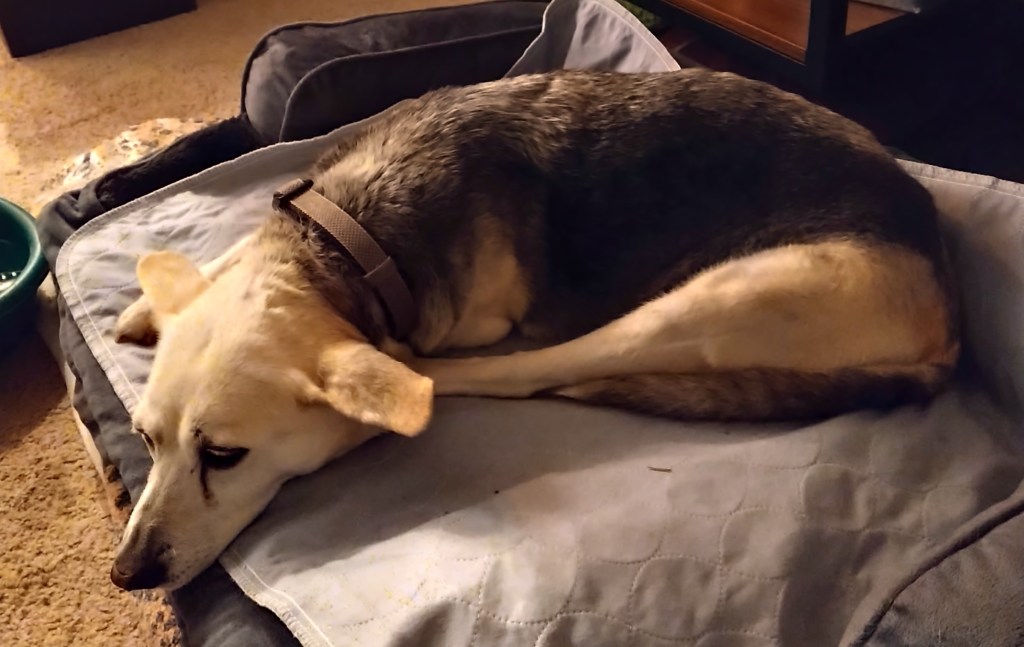
Chloe is dying.

Chloe, watching and waiting

Of course, we all are. But it’s become clear that Chloe’s time is drawing near. It seems to be something in her liver.

Chloe is our dog, or we are her humans. Since less than forty-eight hours after her arrival, who belongs to whom has not been entirely clear. We thought that going to the shelter and fetching her made the initiative ours. We were going to take charge and be good caretakers: no table scraps for this one, and she would have her own bed in her own special place in the house, just like the books said it should be. We had been far too permissive with our previous, beloved canine companions. But after putting her in her bed in that special place on the second night and retiring to our own bed, she stole the initiative from us. Not fifteen minutes later her furry chin plopped onto the bench seat at the foot of our bed. She looked each of us in the eye, and in a flash had occupied the territory at the foot of our mattress from which she would capture and hold our hearts.

I was taught early on to believe in an afterlife. The nature of it is less clear than it was when I was a child, and my tolerance for that uncertainty has grown even as my faith in its existence has deepened. Maybe it will be a place where we will meet our loved ones–including our animals. Maybe it will be the colorful painting come to life that Robin Williams and his dog romped through in What Dreams May Come. Like many others losing beloved animals, I have taken comfort in the simple image of crossing the rainbow bridge, from a poem by Paul Dahm. Perhaps it’s simply a remerging of our substance with the universe from whence we came. What I have learned about science gives me hope. If matter and energy are preserved, then how could that spark that defines our beings be lost?

Chloe came to us, and we to her, several months after the passing of another dog rescued from a shelter, Sassie. We thought we had had enough of the pain of separation and would wait awhile before starting that journey again. (It was, perhaps coincidently, around the time that my father began his nearly year-long journey out of this life.) Then we saw Chloe’s picture on the shelter website. She was looking off to her right. Returning to the picture the next day, her gaze seemed to have shifted. Had they changed the picture? She was now looking directly into the lens of the camera. She had seen us. Since that day she has never stopped watching and listening to us intently, waiting to see what we would do.

She is waiting still; hanging on to the spark of life that defines her. Even as we have claimed to be her caretakers these past twelve years, she has taken care of us; held us in her gaze and her heart and kept us from losing ourselves in our own crap. Now it’s time for us to take care of her. In all likelihood, we will have to make the decision to send her off on the rest of her journey–not when we’re ready, but when she is. It’s time for us to really watch and listen.

Shedding 2020

The new year has already begun for most of the world, including many people I love. But in the hours left to me in 2020, there is something I need to acknowledge so that I can move into a better, more hopeful new year.

We Americans have come face to face with some hard truths about ourselves in this year. We have seen the grisly injustice in our history and in our present reality laid bare. Yet nothing has struck a chord of despair in me so much as learning just a little on this New Years Eve about the still unmarked graves of hundreds of slaves on the grounds of our first president’s estate, George Washington’s Mt. Vernon. So many lives stolen and forgotten; so many dreams denied!

We should at least know their names. Perhaps we never will, and that weighs on my conscience. I wasn’t there; I didn’t participate in that original sin; I didn’t hold those chains. Still, throughout my life, I have stood on foundations built by those women, men, and even their children. And I have profited from the legacy of that wrong, and others. Further, I have been nurtured on and by land stolen from others.

We should at least know their names.

I hope that in this new year, we can do much more to throw off the weighty chains of a history that holds us captive. What does that mean? Perhaps it begins by listening to each other. As I so often say to the orchestra, listen more than you play. Our number one job is to listen. This night, I have never been more convinced of that truth.

I am sorry to inject this dark note into what is usually a celebratory night. But this seems like a good time to shed some baggage that we all have been carrying for far too long. We can make 2021 a much brighter and better year.

Raging Against the Wind

Raging Against the Wind

by Jeffrey Bell-Hanson

Don’t misunderstand what I am about to say. Rage can be useful. Rage can move hearts. Rage can be what is needed.

But rage is only effective within and among those who recognize it, empathize with it, and, perhaps, understand it. I can fly into a rage and frighten my dog, make my wife understand that I really do care about this thing, or shock my students into really listening. (Honestly, I can’t complain about any of these constituencies. I am blessed beyond measure.)

But raging against a virus seems like simply raging against the wind. The wind won’t listen, it will probably drown out your shouting, and it may even deprive you of breath.

This virus is so much smaller than we are. How many times the mass of a Covid-19 molecule, is the mass of an average human adult? How much more self-aware am I, or are you, than this virus? How beside the point are these questions?

Yes, it is small. But in its numbers and its ubiquitous presence across our entire planet, it is so much bigger than we are. I may be assuming too much here, but I suspect that it doesn’t care nearly as much about the death of an individual virus molecule as we care about the death of individual humans.

So how should we respond?  I see two choices.

  1. We can rage against the wind. We can respond to this virus as if it were a human adversary, or an anthropomorphized devil. We can present a defiant face. We can set our chins and draw lines and say, “no further!” (One of my favorite moments from Star Trek: First Contact!)
  2. Or, we can recognize how completely useless all of that is in the face of a virus. It cares nothing for us, or our hardship, or our rage. It lives to serve itself, and no more. (Hmm. Sounds eerily familiar.) It will not respond to our rage. It will only look for something or someone else to consume. It isn’t evil. It simply is.

As a musician, I can choose to be defiant, and say, “You will not stop us from doing what we have always done.” That might feel good. And it asserts the primacy of human culture over an entropic vision of the future. But it’s beside the point. It presumes an enemy who cares.

Or, as a musician, I can stop. Find shelter from the wind—even while I recognize its cunning and effectiveness—and do what musicians do best: LISTEN.

This pandemic has already prompted us to stop doing what we were doing. We can dedicate ourselves to raging against the pandemic and making it our priority to go back to what we had always done.

Or…we can listen, act in humility, and learn how to express how it feels to be human in a new age—one in which we understand that we are not so smart as we might once have believed. If we have to let go of the past, so be it. Rage, in this case, will not bring that past back. It will only make it more difficult to move forward.

Finding Voice

This blog started as a place for contemplation of what we leave in our wakes as we move through life. I have sometimes deviated from that purpose, but it remains my principle focus. There are lots of ways that we affect those around us—or the earth, or the universe—as we walk our paths, but for some of us, words are the most important tools that we have. So, it is a problem when one can’t find any; no words to speak or write about something that has triggered a signal moment for our community, our nation, our world.

Don’t take my silence before this post as a sign that I don’t feel deeply wounded by the injustice so brutally displayed by the murder of George Floyd, or Breanna Taylor, or Philando Castile, or the legions of other African Americans whose lives have been taken by those who should have been protecting them. As a white man I can’t claim to have a visceral understanding of the fear experienced by people of color when they encounter a policeman, or by women who face a threatening world every day. Yet as an American I have a deeply rooted sense of justice, one that is reinforced, not overridden, by my faith. When I see such monstrous inhumanity, my heart aches for those victims, and the flame of my hope flickers in the ill wind of despair.

Ah, but…if you ask me why it has taken so long for me to see, I have no good answer. Maybe it’s the way I was taught—or not taught. Maybe it’s the zero-sum mentality that I have railed against before, but in which I have been steeped all of my life; a mode of thinking that demands others to lose in order for me to gain. Maybe it’s the necessity I have felt to busy myself with my own plans and schemes that leaves me little time and no energy to be my brother’s keeper. Maybe Noam Chomsky was right to observe that the power structures in our society are designed to strip us of our sense of empathy.

Maybe those are all excuses. Maybe it’s just always been easier to keep my head down; not speak up; be glad it’s “them,” not me.

But the time has come for me to raise my voice. As all humankind is being ravaged by a virus that knows no boundaries, has no limits, and sees no color, the ugly truth about our own propensity for bigotry and injustice has never been more clear. On top of that, the virus has forced me to slow down. It has given me the time to stop and look, and taken away whatever excuses I may have had for not seeing—or speaking.


Photo from TwinCities.com (Pioneer Press)