by Jeffrey Bell-Hanson
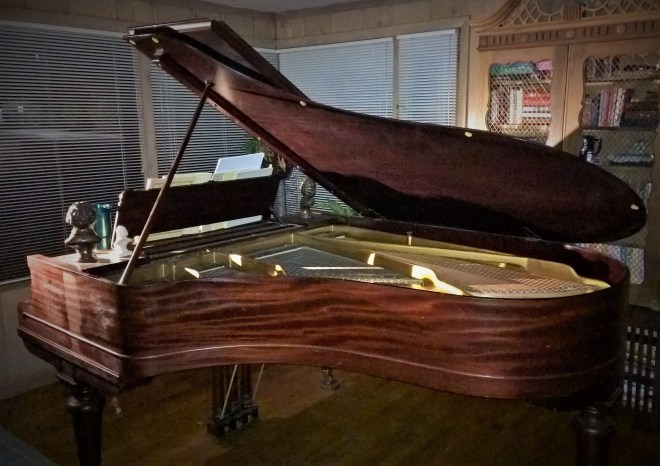 This picture of my piano, Henry F. Miller 40603, has appeared in my blog entries before. I’m including it in this one because I am thinking about the arc of its history. Made in 1910, this piano is now going through its second global pandemic.
My best efforts so far have not been able to conclusively determine the specific history of this instrument, but it seems likely that it had been purchased by someone in the Keweenaw Peninsula of Michigan soon after it’s manufacture. The area was at or near the peak of its population around that time. Some figures put the number at between 95 and 96 thousand, some as high as 111 thousand plus. (The Keweenaw today has around 38 thousand residents.) There was a wide income gap between the average mine worker, who probably made less than a thousand dollars a year, and the mine owners and executives. Only the latter would have been able to afford the $750 price-tag of this instrument at the time.
Yet this was a time when a piano—especially a magnificent parlor grand like this Miller—would have been an aspirational object for anyone seeking to be recognized as having achieved a certain social status. Wages had gone up considerably across the nation as the first world war came to a close in 1918. Yet, just as the economy was on the move, so were people and the virus that caused the Spanish Flu.
Waves of the pandemic would continue in Michigan’s Upper Peninsula until 1921. During that extended period, the Miller was probably in someone’s house in Calumet or Houghton, perhaps one of the few distractions to which a family could turn in order to keep their minds away from the terror lurking all around them. Ironically, it’s even possible that its keys helped to spread the virus at one time or another. But mostly, it was surely an island of solace in a sea of doubt; a tangible reminder that beauty and joy could still be found in the singing of a song together.
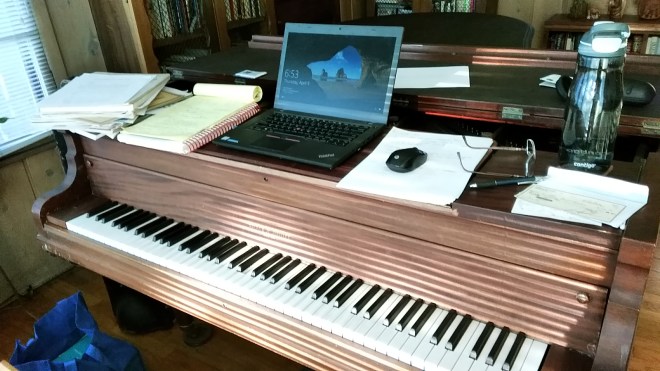 This is how the Miller looks in this global pandemic, 102 years later. It’s not so much providing solace for a family as it is helping to provide stability for students. It has become the platform (figuratively and literally) from which I interact with them online. It’s helping to keep their educational experience going, providing them with at least a hint of normalcy, and making it possible for me to continue to do at least part of my job. While I don’t know for sure, its voice may be traveling farther in this circumstance than it has in its entire history up to this episode.
The Miller has proven its durability in the last 110 years. Its likely to be around long after I am gone. However long it lasts, I only hope that this will be its last global pandemic.
 Beating in Air