by Jeffrey Bell-Hanson
Dear Readers,
For the last two weeks I have been away from home—not from everything that I love, but from many of them: my wife, my dog, my home in the Pacific Northwest, and from my piano. Ironically, it’s the piano that sent me off. If you have read some of the other posts in this blog you know all about my journey of discovery this year. I am trying to learn something about the history of Henry F. Miller 40603, the grand piano made in 1910 that has been in our household for over twenty of its years.
This last leg of my journey took me to the University of Maryland’s Michelle Smith Performing Arts Library and to the Library of Congress to see the Presto Buyer’s Guide to Pianos and Player-Pianos and Reproducing Pianos from multiple years of publication in the early part of the last century. It gave me a sense of where the Miller company stood in the pantheon of American piano makers. They had a reputation for an uncompromising pursuit of their founder’s goal of making artist-quality instruments. That was further reinforced by a visit with Charles Jackson, a technician, piano restorer, and piano historian in Hopkinton, Massachusetts, who showed me some of the measures that Henry F. Miller and Sons took to engineer their pianos to last. That explains a lot about number 40603. [http://www.pianomuseum.org/lobby.php]
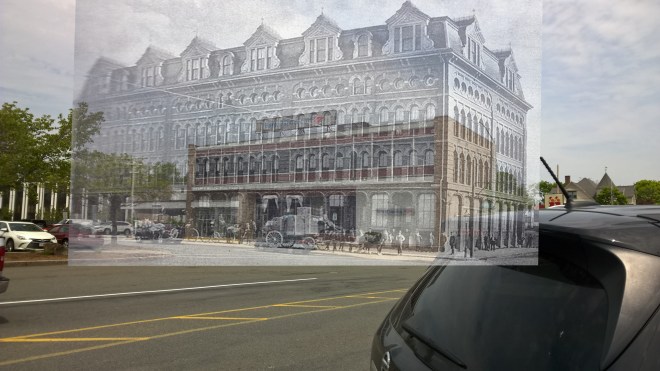
I visited the site of the Miller factory in Wakefield, Massachusetts where my piano was made over a century ago. Whatever expectations I might have had about finding hallowed ground, what I actually found was this rather homely little bank, a tire store, and a parking lot all inhabiting that space where great musical instruments were once made with such dedication and care.
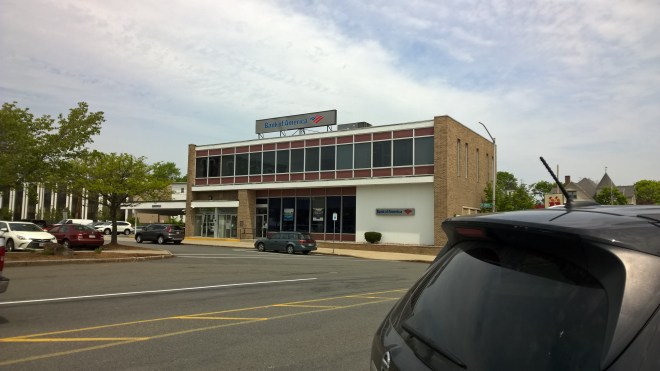
But the streets were all there, and I could almost picture the old factory and the ornate town hall that sat next to it.
Equally interesting was my trip to see the Frederick Historic Piano Collection in Ashburnham, Massachusetts [http://frederickcollection.org/] where Patricia Humphrey Frederick and Edmund Michael Frederick curate a marvelous collection of twenty-eight working, historic pianos that date back to the eighteenth century. I spent nearly four hours listening to Edmund talk about and demonstrate most of them, starting with the newest and working our way down to the oldest. I began to get a sense of the evolving sound of pianos, and the craft and technology that has supported it. I sat down at a few and played them just enough to get a feel for the shallow, light and quick action of the older instruments, a characteristic that allowed pianists, in Edmund’s words, to execute passages as if they were making gestures over the keyboards.
This morning, after yesterday’s long journey home, I sat down at the keyboard of Miller 40603. I left the music rack down and just improvised. It was just so much harmonic doggerel, but it allowed me to feel the familiar weight of the action and hear what, now more than ever, sounds like an extraordinarily rich and resonant voice. I heard some wonderful instruments in the Frederick Collection—Erards, Bösendorfers, Blüthners, Streichers, a Steinway, and others. Their voices were distinct. Some were crystallin, some silvery, some richer and warmer, and they all had qualities that made them especially well-suited to music of a particular period, or style, or composer.
As I sat at the Miller this morning a couple of things occurred to me. First is how well suited it is to the music of its time. It was made when some of the late romantics might still have been considered contemporary composers, and some were even still alive. It is resonant, and warm, and lyrical, as their music demands. Second is how much in love I am with its voice. Maybe that’s because it’s familiar—it’s home.
 Beating in Air