 by Jeffrey Bell-Hanson
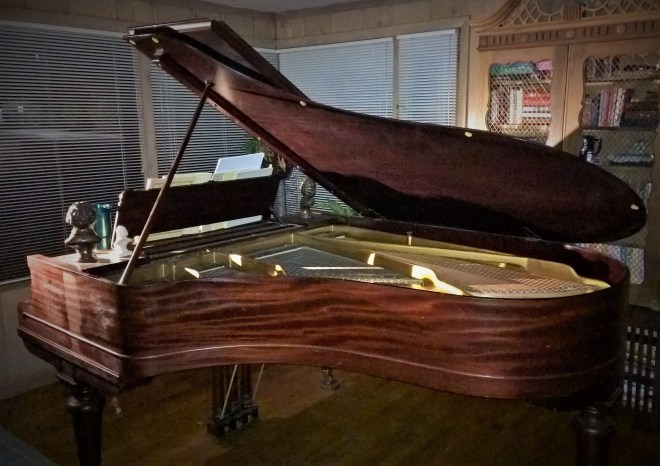
Dear Readers, let me introduce you to my beloved piano, a magnificent instrument that has graced our living room for about 20 years.
It was manufactured by the Henry F. Miller Piano Company of Wakefield, Massachusetts 107 years ago at what one might consider the acme of the company’s history. Miller, as a young man, was an aspiring keyboard artist. However, as has been the case for musicians then and now, he soon realized the need to have a “day job,” and in 1850 joined a then prominent Boston piano-making firm, Brown and Allen.
He founded the Henry F. Miller company in 1863 just as the industrial revolution brought steam-power to factories in Wakefield. While never as large as the behemoth Chickering company in neighboring Boston or Steinway in New York, by the turn of the century it was making instruments that rivaled the quality of pianos made by these two giants, and which were increasingly played by prominent artists of the day.
Like most American piano manufacturers, the Henry F. Miller and Sons label became subject to a long series of acquisitions in the 1920s. Over the course of the decades, the Miller brand became associated with decent, but lower-priced instruments pitched at the entry level of piano purchase. Production of Miller pianos (by the Pearl River Company in China for Sherman Clay in the US) final came to an end in 2013 with the closing of the Sherman Clay stores.
This specific piano can be traced through its serial number to the original Wakefield factory in 1910. It is 6 feet and 9 inches long, which makes it roughly equivalent in size to the Steinway B, the instrument with which it was no doubt meant to compete. The size makes it best suited for smaller recital halls and studios, though it is sometimes found as well in music rooms in larger homes. Without doubt, it is a pianist’s instrument (though I make no claims for myself), not generally what one would purchase for occasional sing-alongs in the parlor.
I acquired it in a remote corner of Michigan years ago after it had been donated to the university at which I was employed. At the time there was no suitable place for it, no immediate use for it, and no budget to do the sort of restoration that a (then) 87-year-old piano needed. Making matters worse, it suffered the collapse of one of its legs when it was not moved carefully enough. After the damage was repaired, the decision was made to not risk the same thing happening again, and it was sold, as is, for what was deemed a fair price—to me! Even after the accident, it still holds pitch beautifully and has a powerful sound throughout its range, indicating that the soundboard is likely in good shape.
Now for the mysterious part, and the object of my quest: How did it get from Wakefield to this rural mining area on the Lake Superior shore? Who brought or purchased it there? How did they use this large, artist-quality instrument? Was it in a ballroom, a house, perhaps in a church hall? Was it purchased by a wealthy mining company executive for an especially serious pianist in the family? Were piano students taught on it? How many lives has it touched and what role did it play in the musical community of this once-thriving mining region?
The one key piece of information that I do not have is the name of the person who donated it to the university. Oddly, there seems to be no record, as if it were left on the doorstep like a baby in a basket. Perhaps its story is not all that interesting. Yet it seems like a once-well-maintained instrument. It’s possible that it has a fascinating tale to tell. Finding clues at this stage, however, is like searching for the proverbial needle in a whole bunch of haystacks.
 Beating in Air